> Development > Ecology and forest


Until about 13 years ago, Krishna Basumatary and other women of her village Majrabari located at the fringe of the Bhuyanpara range the Manas National Park had to rely on firewood, thatch, wild vegetables collected from forest deep inside the protected area for household use and consumption. The risk of wildlife attacks in the dense jungle turned every single trip into the forest a gamble with life. “Back then, life was difficult, and I didn’t know of any other way,” she recalls.
In 2012, she found hope for an end to such uncertainty in life after undergoing a training in mushroom cultivation and pickle making organised by biodiversity conservation organisation Aaranyak.
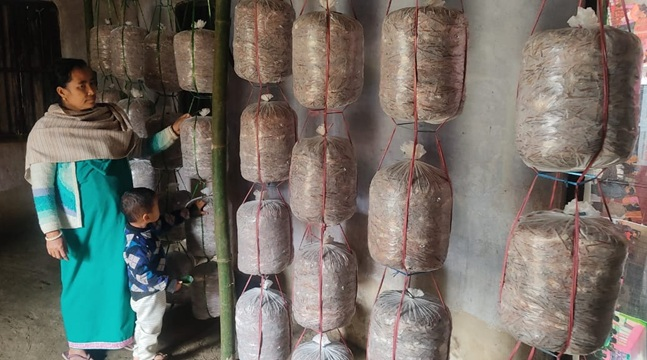
Photo courtesy Aaranyak
Now in her fifties, Krishna has built a sustainable livelihood through her microenterprise of mushroom growing and food processing far away from the danger of forest foraging.
Each batch of mushroom takes about 25 to 30 days to mature, providing both food for her family and an important source of income. She purchases mushroom seeds (spawn) at around Rs. 200 per kilogram packet, which can yield 25-30 kilograms of fresh mushrooms under favourable conditions.
Sometimes, Aaranyak also provides her with mushroom seeds, helping her continue her work when supplies are hard to find in local markets. On other occasions, she even orders the seeds online, and they are delivered right to her doorstep, something she finds remarkable. “Even though our village is on the fringe of the forest, the seeds still reach us. It shows how much things have changed,” she says it with confidence of sustaining her micro enterprise located in the remote village close to India-Bhutan border.
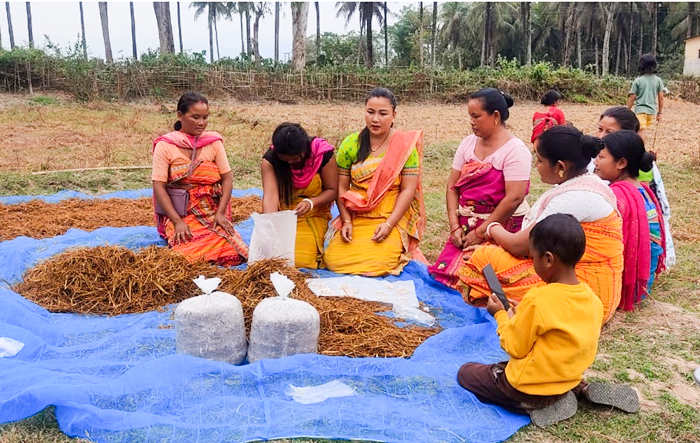
Photo courtesy Aaranyak
Krishna’s interest in mushroom farming took a new turn in 2015, when she took her first batch of mushrooms and homemade juices to sell at the All-Assam Agriculture and Horticulture Show held at Chandmari, Guwahati. “It was a success, and I even made some profit,” she recalls with pride. The positive response encouraged her to expand her production and improve her techniques over time.
Encouraged by that early success, Krishna gradually scaled up production. At one point, she was producing between 250 and 300 cultivation bags of mushrooms. But this expansion also brought challenges. Maintaining the right temperature and humidity, especially during the monsoon and winter seasons, became difficult. “Sometimes the mushrooms spoil before they mature because of too much moisture,” she explains. Contamination and pest attacks have also destroyed several mushroom batches over the years, leading to financial losses. Despite these setbacks, Krishna remains determined to carry on with her enterprising ventures.
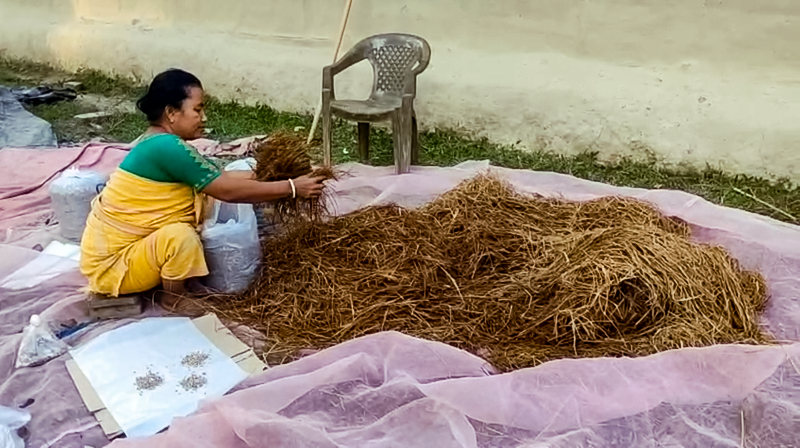
Photo courtesy Aaranyak
To overcome these problems, Krishna and other cultivators received technical guidance from Dr. Sandeep Das of the Department of Biotechnology, Bodoland University, where they were trained on how to protect mushroom seeds from small ants, cockroaches, and excessive moisture. This training helped her adopt better hygiene and maintenance practices, reducing losses and improving the quality of her cultivation.
She now sells mushrooms in nearby Rupahi and Mainao Bazaar, where demand remains steady. Whenever tourists or guests visit the Aaranyak office near the national park, she brings her mushrooms and homemade juices to sell there as well. During local events like the Manas Festival, she sets up a stall to sell her mushrooms, pickles, and fruit juices, which attract both local residents and visitors. Over time, her products have gained such popularity that many customers now come directly to her home to buy mushrooms, pickles, and juices, knowing they are fresh and homemade.
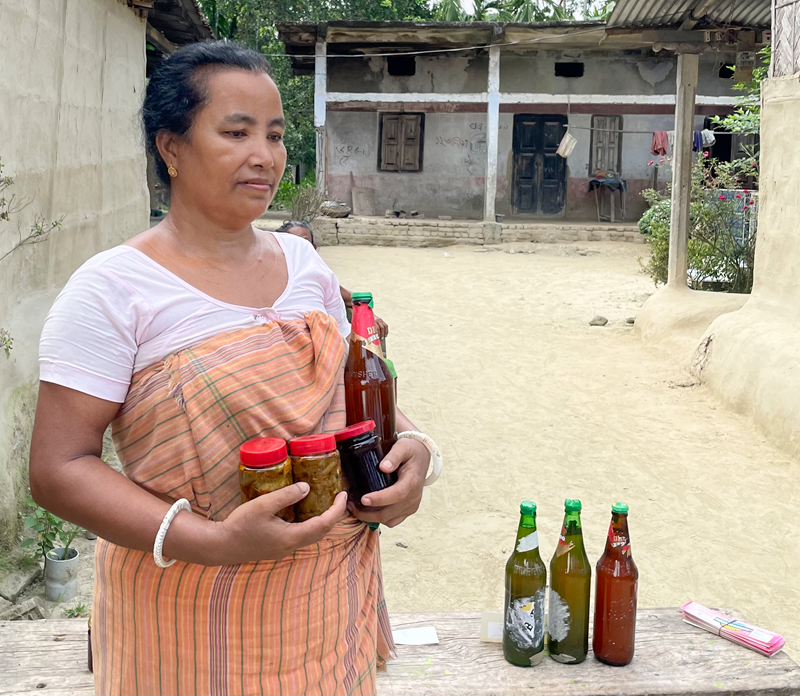
Photo - Preety Boro
Krishna sells her mushrooms at Rs. 40- Rs. 50 per 250 grams, depending on the season. This means she earns between Rs. 160 and Rs 200 per kilogram. From packet of seeds, which costs Rs 200, and produces up to 30 kilograms, she can earn a total of Rs. 4,800- Rs 6,000. After deducting expenses for straw, plastic bags, and maintenance, she makes a net profit of around Rs. 3,300- Rs 3,800 per cultivation cycle, a meaningful income for her family in a rural setting.
She also prepares jelly mushrooms, which she sells at Rs. 185 for 300 grams, a product that has become quite popular among visitors for its unique texture and flavour.
Over the years, Krishna has also participated in several major exhibitions and fairs to showcase her products. She took part in the North East Agri Fair 2023 at Khanapara, Guwahati, where her mushroom and fruit-based products drew appreciation from visitors. She has also displayed her products at the Dwijing Festival in Bongaigaon, the Bodo Sahitya Sabha in Mushalpur, and the Ahom Sahitya Sabha at Simlaguri, Barpeta Road, where she received positive feedback from the public. Through these platforms, Krishna not only sold her products but also inspired others to take up small-scale, eco-friendly enterprises.
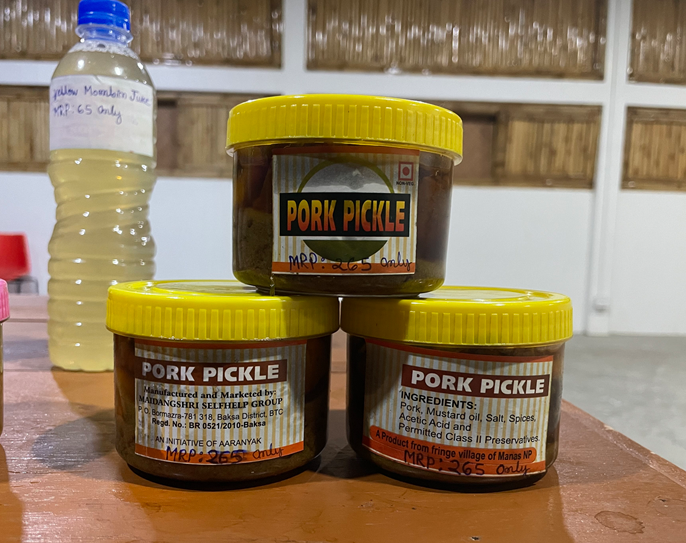
Photo - Preety Boro
Alongside mushroom farming, Krishna has also diversified her livelihood by making pickles and fruit-based products using locally available ingredients. She prepares pickles from mango, king chilli, olive, and pork, and makes plum jelly and juices from fruits such as dragon fruit, plum, blackberry, gooseberry, and mombin. However, these ventures too come with challenges. During the rainy season, drying ingredients becomes difficult, and proper airtight containers are costly and hard to find in the village. “Sometimes the pickles spoil before I can sell them all,” she says.
Krishna’s creativity doesn’t stop there. She has experimented with mushroom pickles, and even jelly and juice made from mushrooms. Beyond that, she has tried her hand at making pumpkin pickle, tomato sauce, jackfruit jelly and juice, and papaya jelly. Today, she proudly makes 42 varieties of juices, pickles, and jellies, each one crafted from ingredients available in and around her village.
Reflecting on her growing popularity, Krishna smiles and says, “When people come all the way to my home to buy what I have made, it makes me truly happy. It shows that my hard work is valued and that even from a small village, I can make a difference.” She adds with pride, “It’s a great pleasure for me that I got training from Aaranyak, and my products are now taken by tourists to different places that I couldn’t even think of.”
Her success has also turned her into a trainer and motivator for others. Along with her trainer Malamoni Hazarika, Krishna has conducted training sessions on mushroom cultivation and pickle-making for villagers from the boundary areas of Bargaon and Panbari. “There were around 40 people in the training,” she recalls, pleased that she could share her knowledge with others seeking sustainable livelihood options.
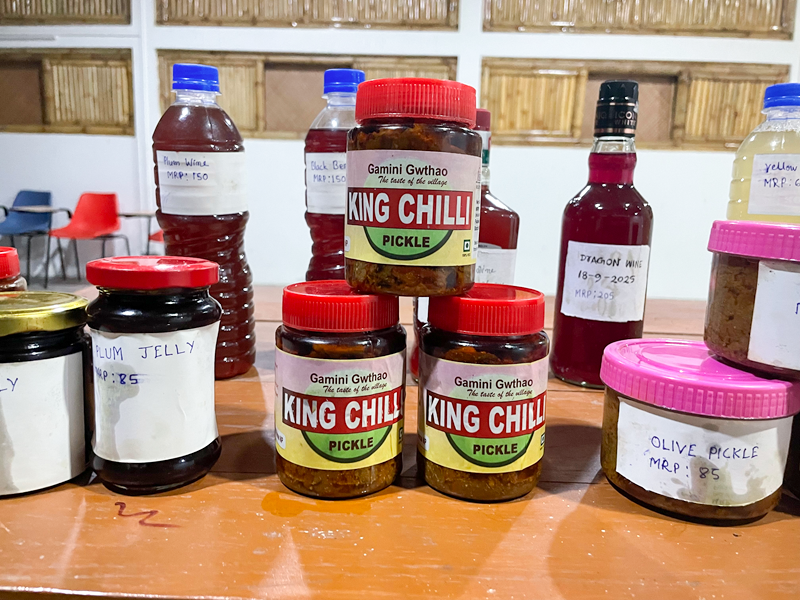
Photo - Preety Boro
Krishna lives with her family of seven, who support her in her work. “There are times it gets difficult, but I don’t want to stop,” she says. For her, mushroom cultivation and homemade products are not just about income, they are a way to build a sustainable future without depending heavily on forest resources.
Krishna’s journey mirrors a broader shift among fringe communities around Manas National Park, where people are increasingly adopting eco-friendly and sustainable livelihoods. future. The brand name of her products ‘Gamini Gwthao’ meaning ‘the taste of the village’ tells an inspiring story of how local innovation and women-led eco-friendly micro-enterprises can help rural families thrive; and how even small and remote villages like Majrabari are becoming part of a larger conservation success story of a World Heritage Site like Manas National Park.
 Navigations
  Quick Contact
 Subscribe Us
 Quick Mail